


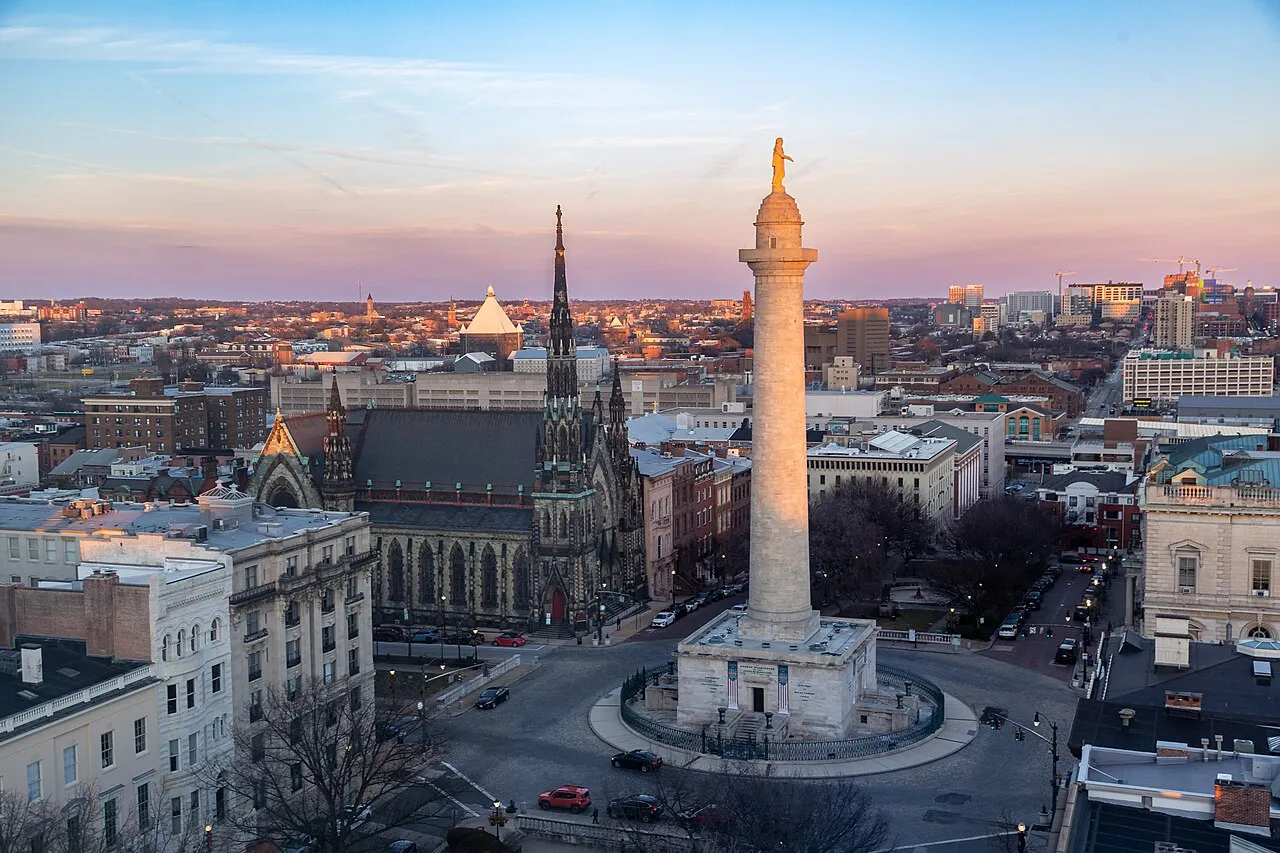
North of Downtown, Mount Vernon gathers garden squares, museums and residential streets around Baltimore’s Washington Monument. East of the Inner Harbor, Fells Point faces the water, with stone-paved streets and buildings inherited from the city’s maritime economy.
The Mount Vernon–Belvedere and Fells Point profiles explore these two areas in more detail. The Baltimore city overview introduces the wider city; the neighborhood directory links to available area guides.
Mount Vernon: garden squares and surrounding streets
Four narrow garden squares extend from the Washington Monument, bordered by houses and cultural institutions. The Mount Vernon Place Conservancy maintains the monument and gardens with the city and runs public programming, including outdoor concerts, films, Flower Mart and the annual Monument Lighting.
Charles Street continues through the area as a shopping and dining corridor. Read Street combines small businesses with historic residences, while Hamilton Street retains a block of early nineteenth-century townhouses. The Mount Vernon–Belvedere Association represents Mount Vernon, Midtown-Belvedere and adjacent blocks, extending beyond the monument squares.
Two public interiors near the monument
The Walters Art Museum at 600 North Charles Street has free admission. Its main entrance is on Centre Street near Cathedral Street, also the entrance the museum recommends for visitors with limited mobility. The museum’s visitor page lists current hours and entrance changes.
At 17 East Mount Vernon Place, the George Peabody Library’s reading room rises through five tiers of cast-iron balconies to a skylight. The building opened in 1878 and remains a research library. Public access is free and limited to the ground floor; Johns Hopkins publishes a date-specific visiting calendar.
Fells Point: streets shaped by the port
Fells Point developed as a deep-water port and shipbuilding center. Surviving buildings held the homes and businesses of merchants, sailors, immigrants, and enslaved and free Black residents. Along today’s waterfront, restaurants and shops share those older streets, and Broadway Market provides an indoor food stop.
At 1417 Thames Street, the Frederick Douglass–Isaac Myers Maritime Park Museum occupies a historic waterfront industrial building. Exhibits follow Frederick Douglass’s years in Baltimore, Isaac Myers’s work and the founding of the Black-owned Chesapeake Marine Railway and Dry Dock Company.
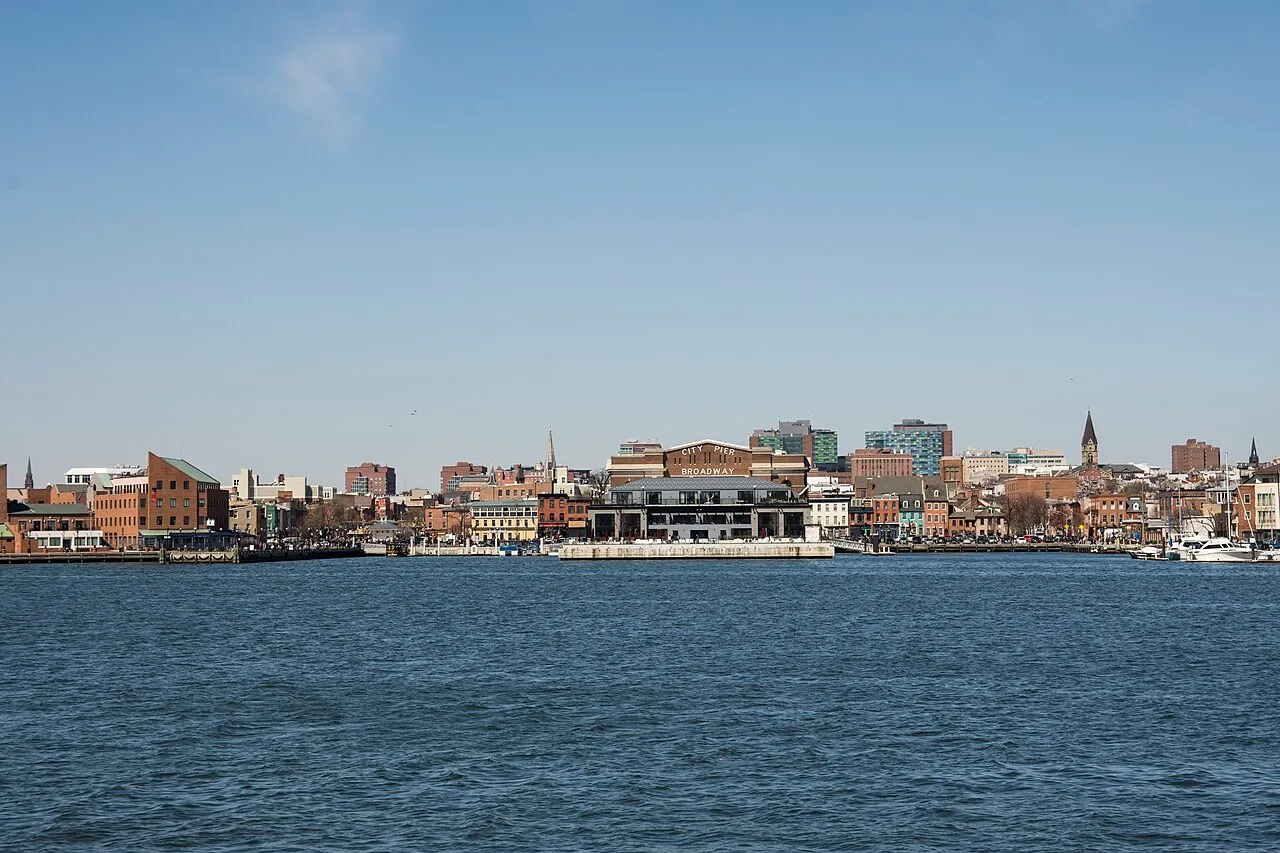
Photo: Bruce Emmerling; CC BY-SA 4.0. Resized and converted to WebP.
Merchant and workers’ houses off the waterfront
Robert Long’s brick house dates to 1765, when the merchant established himself in the developing waterfront community. The residence at 812 South Ann Street is now a house museum interpreting colonial domestic life, with private tours arranged through the Preservation Society.
The small timber Ship Caulkers’ Houses at 612 and 614 South Wolfe Street tell another part of the port’s history. Built around 1798 as inexpensive rental housing, they are connected with Fells Point’s free Black community before the Civil War. Their exterior rehabilitation is complete; the project’s published update describes interior restoration as ongoing.
Rail reaches Mount Vernon’s western side
MTA’s Light RailLink includes the Mount Vernon/Centre Street stop, between Lexington Market and Cultural Center/State Center on the central-city corridor. The Walters identifies Centre Street as its nearby light-rail stop. This is an inland rail corridor; Fells Point’s waterfront lies to the east.