


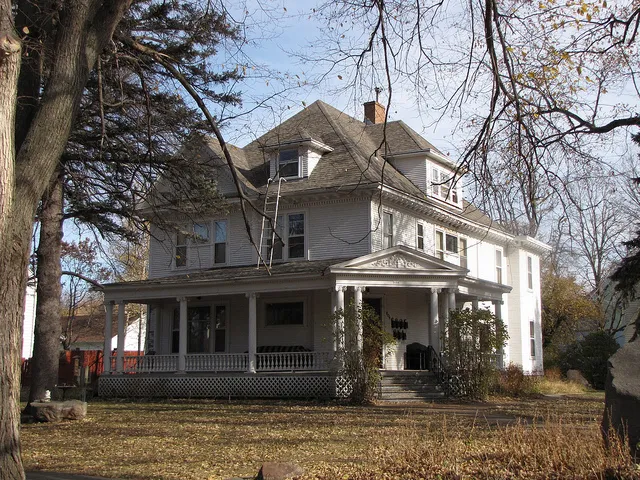
The University Residential Historic District is one of Brookings' established residential areas, known for its historic homes, traditional street layout, and close connection to South Dakota State University. Located northeast of downtown Brookings and southwest of the SDSU campus, the neighborhood combines late 19th-century and early 20th-century architecture with access to university activities, downtown businesses, museums, and local services. For people considering a move to Brookings, the district offers an opportunity to explore an older residential neighborhood with a distinctive architectural character.
Understanding its housing options, historic preservation considerations, nearby schools, and transportation connections can help prospective residents decide whether the area fits their needs.
Where Is the University Residential Historic District?
The Brookings University Residential Historic District covers approximately 17 full and partial city blocks between downtown and South Dakota State University. Its approximate boundaries are:
North: Harvey Dunn Street
South: Sixth Street (U.S. Highway 14)
West: Fifth Avenue
East: Medary Avenue
The official historic district boundary is irregular and follows individual property lines in several locations. Not every property within these general street boundaries is necessarily included in the designated district. The district is separate from the SDSU campus itself and from the Brookings Central Residential Historic District, which is located south of Sixth Street. Its location provides access to two important parts of Brookings: the university campus and the downtown commercial area centered around Main Avenue.
History: How the Neighborhood Developed
The neighborhood's development is closely connected to the growth of Brookings and South Dakota State University. SDSU traces its beginnings to 1881, when the Dakota Territorial Legislature authorized the establishment of an agricultural college in Brookings. As the college expanded, the surrounding community needed housing for faculty members, employees, students, business owners, and other residents. The University Residential Historic District developed during this period of residential growth.
Historic research shows that some professors and university employees established homes in the neighborhood. Students also lived in rental houses, apartments, boarding houses, and rooms rented within private residences. Many of the district's historically significant houses were constructed between approximately 1895 and 1948. The neighborhood was listed on the National Register of Historic Places on 1999, in recognition of its architectural significance and its association with community development.
Today, the district remains a residential area, rather than a museum or a university-owned historic campus.
Housing and Architectural Character
Architecture is one of the district's defining features. The neighborhood contains houses representing several important periods in American residential design. Among the architectural styles documented within the historic district are:
Queen Anne and Folk Victorian: Traditional houses with varied rooflines, decorative elements, and porches.
Craftsman and Bungalow: Homes often characterized by practical layouts, broad eaves, and covered front porches.
American Foursquare: Generally two-story houses with compact, rectangular or square layouts.
Colonial Revival: Homes featuring traditional proportions and classical design influences.
Prairie and Tudor Revival: Additional examples of residential design from the early 20th century.
Minimal Traditional and Ranch: Simpler residential forms reflecting later changes in housing preferences.
Not every home belongs to a recognizable architectural style. Many houses represent traditional building forms that were common in the region. Historic district documentation also describes mature trees, sidewalks, landscaped yards, and alleys behind many residential lots. These physical features contribute to the neighborhood's established character.
What Types of Housing Are Available?
The district has historically been dominated by single-family houses, but it has also included rental homes, apartments, and former boarding houses. This combination reflects the area's longstanding connection to university life. For prospective buyers, the neighborhood offers opportunities to consider older houses with architectural details and layouts that may differ from newer suburban construction. For renters, available options may include individual houses or apartments, depending on current listings.
The district's National Register documentation does not provide a current inventory of properties available for sale or rent. Anyone comparing housing options should verify current availability, building condition, rental terms, and property-specific restrictions.
What Is Everyday Life Like?
Life in the University Residential Historic District is influenced by its location between downtown Brookings and SDSU. The neighborhood's traditional street grid and sidewalks can make walking practical for some local trips, depending on the specific address and destination. Residents may find it convenient to visit campus events, explore nearby museums, or travel into downtown Brookings for restaurants and other activities. The university plays an important role in the surrounding community.
Academic schedules, athletic events, and campus activities can affect traffic, pedestrian movement, and parking demand in nearby streets. However, the experience may differ significantly between individual blocks. Properties closer to major corridors or university facilities may have different surroundings from houses located farther inside the residential area. For someone considering a move, visiting the neighborhood on a typical weekday and during an SDSU event can help reveal these differences.
Shopping, Restaurants, and Everyday Services
The historic district is mainly residential rather than commercial. Most shopping and everyday services are found in surrounding parts of Brookings.
Downtown Brookings
Downtown Brookings, particularly the Main Avenue area, offers a collection of locally operated restaurants, cafes, specialty shops, and service businesses. This commercial area is relatively close to the University Residential Historic District, although the convenience of walking depends on the specific starting address. Downtown also hosts community activities and cultural events throughout the year.
Groceries and Essential Services
Brookings has supermarkets, pharmacies, banks, personal services, and other businesses serving daily needs. Most full-service grocery shopping is located outside the historic district itself. For residents who prefer not to drive, the distance to particular stores and transportation availability should be evaluated before choosing a property.
Healthcare
Brookings Health System provides hospital and medical services for the community. Brookings Hospital, located at 300 22nd Avenue, offers inpatient, outpatient, surgical, and emergency care. The hospital's emergency department operates 24 hours a day. Additional clinics and healthcare providers operate throughout Brookings. Residents should confirm provider availability, insurance participation, and transportation arrangements based on their individual needs.
Schools and Education
The neighborhood is within the broader service area of Brookings School District 05-1.
Public Schools
The district operates three elementary schools:
Additional public schools include Camelot Intermediate School for grades 4–5, George S. Mickelson Middle School, and Brookings High School. Important: Elementary school attendance boundaries were revised for the 2026–2027 school year. Because assignments depend on the student's residential address, a home in the University Residential Historic District should not automatically be associated with any one elementary school. Families should confirm enrollment eligibility, school assignments, and transportation arrangements directly with Brookings School District before making a housing decision.
Official school information and attendance-boundary resources are available at Brookings School District.
Preschool and Child Care
Brookings has both public and private early-childhood education and child care programs. Examples include the SDSU Laboratory Preschool, SDSU Early Learning Center, and preschool programming through Brookings School District. Families can also explore other licensed child care providers in the city. Enrollment requirements, ages served, operating schedules, and available spaces vary by provider. South Dakota maintains a public child care licensing directory that families can use when researching programs.
South Dakota State University
SDSU is one of the district's most important nearby institutions. The university provides undergraduate and graduate education, research opportunities, athletic events, and public cultural activities. For people who work or study on campus, the district's location may be particularly convenient. Other residents may also appreciate being close to lectures, performances, museums, and university-sponsored community events. Actual walking distances to particular campus buildings vary by address.
Parks, Museums, and Recreation
Although the University Residential Historic District is primarily a neighborhood of homes, residents can explore several cultural and recreational destinations nearby and elsewhere in Brookings.
South Dakota Art Museum
1036 Medary Avenue Located on the SDSU campus near the intersection of Medary Avenue and Harvey Dunn Street, the South Dakota Art Museum is one of the closest cultural attractions to the district. The museum features regional and contemporary artwork, exhibitions, and educational programming. General admission is free.
South Dakota Agricultural Heritage Museum
977 11th Street Located on the SDSU campus, this museum explores the history of agriculture in South Dakota. Exhibits focus on agricultural practices, technology, rural communities, and the development of the region. It offers another educational destination near the neighborhood.
Children's Museum of South Dakota
521 Fourth Street Located in downtown Brookings, the Children's Museum of South Dakota offers hands-on exhibits and interactive activities. Its indoor and outdoor play environments provide opportunities for imaginative and educational play. The museum is a useful recreational option for families looking for activities beyond neighborhood playgrounds.
Brookings Public Library
515 Third Street The Brookings Public Library provides books, digital resources, public computers, educational programs, and activities for different age groups. Its children's programming, reading resources, and community spaces make it a valuable service for Brookings residents.
Pioneer Park
Sixth Street and First Avenue Pioneer Park is located west of the historic district. Its amenities include playground equipment, sports areas, shelters, open space, and a historic bandshell. The park is also known as the location of the Brookings Summer Arts Festival.
Hillcrest Park
1520 Sixth Street Hillcrest Park is located farther east in Brookings. It offers playground equipment, tennis courts, a basketball court, paved walking paths, shelters, and additional recreational space.
McCrory Gardens
631 22nd Avenue McCrory Gardens is a botanical attraction associated with SDSU. It contains formal display gardens and an arboretum featuring trees, shrubs, flowers, and other plant collections. The gardens provide opportunities for walking, seasonal visits, and learning about plants suited to South Dakota's climate. These attractions are distributed throughout Brookings, so transportation needs vary depending on where residents live.
Transportation and Getting Around
Walking
The neighborhood's relatively compact historic layout and existing sidewalks can make walking an option for some daily activities. The closest parts of the SDSU campus and downtown are especially relevant destinations. However, walking conditions vary with weather, intersection design, traffic, and the specific route. Sixth Street is a significant east-west traffic corridor along the southern edge of the district.
Bicycling
Brookings maintains a citywide network of recreational trails and bicycle connections. Bicycling may be an option for travel between the neighborhood, downtown, and SDSU, depending on the route and individual preferences. Residents should review available bicycle facilities and roadway conditions rather than assuming every street has a dedicated bike lane.
Driving
Sixth Street connects the area with other parts of Brookings. Interstate 29, located east of the central city, provides regional highway access. A car can be convenient for supermarket trips, work destinations outside central Brookings, and travel to surrounding communities. Parking conditions should be checked individually. Historic homes may have detached garages, driveways, or limited off-street parking.
Public Transportation
Brookings Area Transit Authority (BATA) offers transportation services to the community. Regular BATA service is primarily based on advance reservations rather than a frequent, fixed-route city bus system. It provides transportation for purposes such as work, school, shopping, and medical appointments. BATA also operates Rabbit Ride, a separate evening transportation service with a designated route during portions of SDSU's academic year. Residents who intend to rely on transit should verify current operating schedules, booking requirements, fares, and service availability.
Information is available from Brookings Area Transit Authority.
Climate and Living Through the Seasons
Brookings experiences a continental climate with cold winters, warm summers, and considerable seasonal variation. Winter brings periods of freezing temperatures, snow, ice, and wind. Summer is generally warmer, with thunderstorms possible during the warmer months. For people considering older houses in this neighborhood, climate-related maintenance deserves particular attention. Heating systems, insulation, window efficiency, roof condition, drainage, and basement moisture can all affect comfort and long-term expenses.
Winter Parking and Snow Removal
Brookings has specific winter parking and sidewalk maintenance requirements. During a declared citywide snow parking ban, vehicles may not remain parked on public streets until the restriction is lifted. The city also requires snow and ice to be cleared from sidewalks and curb ramps adjoining properties within 48 hours after a snow event ends. Prospective buyers and renters should clarify off-street parking availability and responsibility for winter maintenance.
This is especially relevant when evaluating historic houses with older garages or limited driveway space.
Historic Preservation and Property Renovations
Because the University Residential Historic District is listed on the National Register of Historic Places, buyers should understand how historic preservation requirements may affect property improvements. National Register listing alone does not automatically prohibit private property owners from making alterations. However, separate state and local laws can apply. In Brookings, certain exterior projects within designated historic districts that require permits may be subject to the city's 11.1 Review process under South Dakota law.
This review is administered through the Brookings Historic Preservation Commission. Anyone planning a major exterior project, addition, demolition, or significant alteration should contact the city before starting work. The requirements depend on the project and the property. More information is available through the City of Brookings Historic Preservation Review.
Important Things to Check Before Buying or Renting
The neighborhood's historic character is part of its appeal, but older properties can present considerations that differ from newer construction.
Building Condition
Evaluate the roof, foundation, basement, heating equipment, plumbing, electrical systems, windows, and insulation. A professional home inspection can help identify issues that are not apparent during a casual viewing. For most housing built before 1978, federal law requires certain lead-based paint information to be disclosed during the sale or rental process.
Renovation Plans
If you intend to modify the exterior of a historic property, verify applicable permits and historic preservation procedures before purchasing. Also check whether the property is designated as a contributing resource within the historic district.
Parking
Confirm the availability and usability of garages, driveways, and on-street parking. Consider how university events and winter parking restrictions may affect your routine.
School Assignments
Families should verify public school assignments by address using the current district boundary information.
Property-Specific Flood Risk
Brookings has updated FEMA floodplain maps that became effective in April 2025. Prospective buyers should review the applicable flood maps and insurance considerations for a specific property instead of assuming conditions are the same throughout the neighborhood.
Neighborhood Activity
The district's proximity to SDSU can be convenient, but it also means that nearby activities may vary during the academic year. Explore the area at different times to evaluate noise, traffic, parking, and the surrounding environment for yourself.
Is the University Residential Historic District a Good Fit?
The University Residential Historic District offers a different residential experience from newer developments on the outskirts of Brookings. Its appeal comes from the combination of historic architecture, established streets, and proximity to both downtown and South Dakota State University. It may be worth considering for people who appreciate older homes, traditional neighborhood layouts, and access to university and community activities. At the same time, practical considerations matter.
Older homes may require maintenance or upgrades, available housing types differ by property, and transportation needs depend on a resident's daily destinations. For some people, proximity to SDSU will be a major advantage. Others may prefer more separation from campus-related activity. The district is best evaluated at the property and block level rather than through broad assumptions about the entire area.
Final Thoughts
The Brookings University Residential Historic District represents an important part of the city's architectural and community history. Its homes reflect decades of residential development shaped by the growth of Brookings and South Dakota State University. Today, its location gives residents access to downtown destinations, educational institutions, museums, parks, and services throughout the city. For someone planning a move, the neighborhood offers a distinctive place to explore, especially when historic architecture and proximity to campus are important considerations.
As with any neighborhood, finding the right home means looking beyond appearances and understanding how the location supports everyday life. Don't just find a home. Find a place where you belong.
School pages for further research
These are schools mentioned in this guide, not guaranteed assignments for a neighborhood. Confirm eligibility with Brookings School District using the exact address and current school year.
Explore Brookings on StrollPlace
Browse Brookings schools and the Brookings city page. School pages describe institutions; confirm attendance eligibility with the district using the exact residential address.
Sources and further reading
Reviewed October 27, 2026. Plans and inventories are distinguished from completed facilities; use current operator and property-specific information for decisions.