


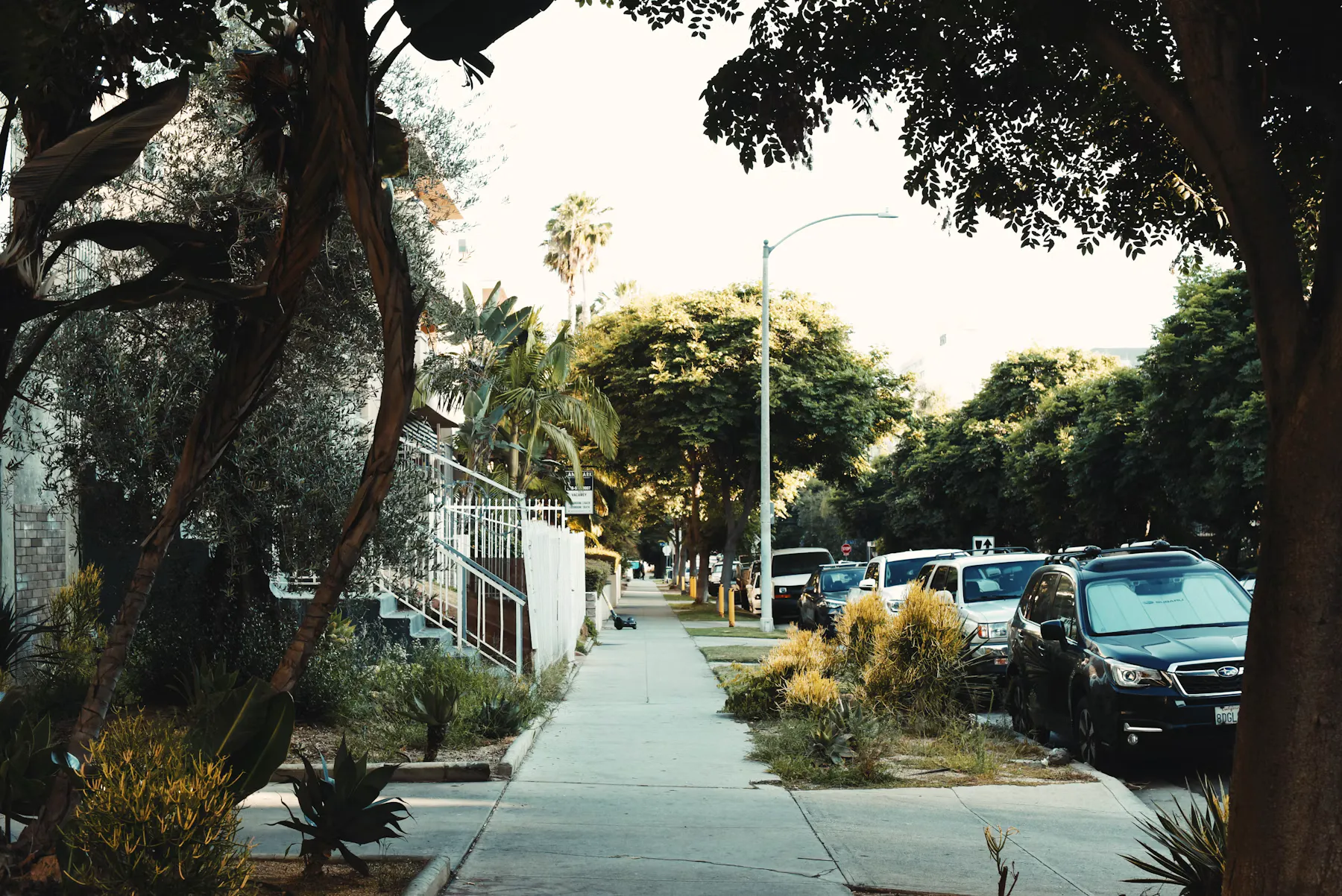
Koreatown offers one of the most distinctly urban versions of everyday life in Los Angeles. Located west of Downtown Los Angeles within the broader Wilshire area, Koreatown combines dense residential development, major commercial corridors, restaurants, cafés, markets, nightlife and unusually strong public-transit access for Los Angeles. But Koreatown is not one uniform experience.
Even its exact boundaries can vary depending on whether you are looking at City Planning areas, neighborhood-council boundaries or commonly used neighborhood maps. That makes the specific building and block particularly important when evaluating what life here may actually feel like. An apartment near Wilshire Boulevard and a Metro station can create a very different routine from one farther inside a residential street or beside a busy nightlife corridor. So instead of asking: Is Koreatown a good neighborhood? A more useful question is:
Does Koreatown make the urban everyday life you want easier?
What Koreatown feels like day to day
Koreatown is a dense, active urban neighborhood where housing, restaurants, stores and everyday services are often located relatively close together. Its major commercial corridors include Wilshire Boulevard, Western Avenue, 6th Street and Olympic Boulevard, with smaller businesses spread throughout the surrounding streets. Depending on the exact address, an ordinary day may involve walking to coffee, groceries, a restaurant, a pharmacy, a gym or public transportation without needing to drive between every stop. That density can be extremely convenient. But density also affects the atmosphere.
More businesses, restaurants and nightlife can mean more pedestrians, more activity and more options close to home. It can also mean heavier traffic, less private outdoor space and more evening street activity on certain blocks. That is why Koreatown should be evaluated at the property level, not just by the neighborhood name.
Metro access: one of Koreatown’s biggest strengths
Public transportation is one of Koreatown’s clearest advantages compared with many parts of Los Angeles. Several Metro rail stations serve the neighborhood and surrounding Wilshire corridor.
Wilshire/Western
Wilshire/Western Station serves the Metro D Line and sits within one of Koreatown’s major commercial areas. Until 2026, Wilshire/Western was the western terminus of the D Line. That changed on May 8, 2026, when the first section of the D Line Extension opened. The subway now continues west through: Wilshire/La Brea → Wilshire/Fairfax → Wilshire/La Cienega That gives Koreatown direct rail access farther west along Wilshire through Miracle Mile and toward the Beverly Hills area. Future sections toward Century City and Westwood/UCLA remain under development.
Wilshire/Normandie
Wilshire/Normandie Station also serves the D Line and is surrounded by a dense mix of housing and commercial uses. For someone living nearby, the station can make trips toward Downtown or farther west substantially more practical without driving.
Wilshire/Vermont
Wilshire/Vermont Station is particularly useful because both the B and D Lines stop there. The D Line provides east-west subway service, while the B Line connects toward Downtown, Hollywood and North Hollywood. This creates one of the more substantial rail connections available within a residential area of Los Angeles.
Bus service
Metro bus routes also operate across the neighborhood, including service along Wilshire Boulevard and other north-south and east-west corridors. The practical question is not simply whether Koreatown “has transit.” It is: Can your actual weekly routine work with it? Before choosing a home, walk the real route from the building to the Metro station or bus stop you expect to use. A station three blocks away and one fifteen minutes away on foot can create very different daily experiences.
Walkability and everyday convenience
Koreatown’s density creates strong potential for everyday walking, but it would be misleading to treat every block as equally convenient. From some addresses, several routine errands can potentially be combined into one walk. For example, commercial centers such as Koreatown Plaza and City Center on 6th, along with numerous smaller businesses, provide groceries, restaurants, retail and services throughout the area. Rather than relying only on a neighborhood-wide walkability score, map the places that matter in your actual routine:
groceries → pharmacy → coffee → gym → Metro → healthcare → home A property that works well for that sequence may feel far more convenient than another apartment only a few blocks away.
Restaurants, cafés and nightlife
Food and nightlife are among Koreatown’s most visible characteristics. The neighborhood has a substantial concentration of Korean restaurants, including Korean barbecue, along with cafés, dessert shops, markets, entertainment and a much broader mix of cuisines. For someone thinking about living here, however, the important question is not whether Koreatown has “good restaurants.” It is what that concentration does to everyday life. You may be able to walk to dinner, meet someone for coffee nearby or find food relatively late in the evening without travelling across the city.
At the same time, restaurants, karaoke venues, bars and other late-night businesses can affect noise and street activity on certain blocks. If possible, visit a potential home at more than one time: weekday morning → weekday evening → Friday or Saturday night A building that feels quiet during a daytime showing may feel very different later in the evening.
Housing: a multifamily urban market
Koreatown’s housing stock differs substantially from detached-home-dominated neighborhoods such as Brentwood, Porter Ranch or Cheviot Hills. Much of the neighborhood consists of apartments and condominiums, ranging from older multifamily buildings to newer mid-rise and high-rise developments. New multifamily and mixed-use development also continues along parts of the Wilshire corridor and surrounding streets.
Current home values
Home-value indices, asking prices and completed-sale prices measure different things. Compare current listings for similar property types rather than treating one neighborhood average as a valuation. They also should not be compared directly with neighborhoods dominated by detached houses. A one-bedroom condominium, a larger condo in a newer tower and a rare detached home are fundamentally different housing products. Property age, size, HOA dues, parking and building amenities can all materially affect the final cost.
Renting in Koreatown
For renters, commercial market data also shows the wide range of prices by unit type. Apartments.com’s October 2026 estimates put average asking rents at about $1,566 for a studio, $1,995 for a one-bedroom, $2,819 for a two-bedroom and $3,734 for a three-bedroom. These are commercial market estimates, not official government rent statistics and not quotes for a particular building. Actual rents can vary substantially depending on the property’s age, condition, location, parking, amenities and unit size. When comparing apartments, the monthly rent should therefore be only the starting point.
Parking: check it before signing
Strong public transportation does not mean every Koreatown resident will want to live without a car. If you plan to keep one, parking deserves attention before you sign a lease or purchase a property. Ask whether parking is included, whether the space is assigned or tandem, whether guest parking exists, whether EV charging is available if needed, whether there are additional monthly charges and what street restrictions apply around the building.
In a dense urban neighborhood, the difference between secure building parking and depending on surrounding streets can materially change everyday life.
Parks and recreation
Koreatown is dense, but there are public recreation resources in and around the neighborhood.
Seoul International Park / Ardmore Recreation Center
Seoul International Park / Ardmore Recreation Center, at 3250 San Marino Street, provides a children’s play area, walking path, outdoor fitness equipment, a multipurpose sports field, indoor basketball courts and community space. Current and recurring programming includes activities such as soccer and futsal, basketball, baseball, gymnastics, volleyball, softball, flag football, dance and track and field, along with seasonal camps and after-school programs. Programming changes throughout the year, so a specific class or sport should always be verified before planning around it.
Shatto Recreation Center
Shatto Recreation Center, at 3191 W. 4th Street, is another substantial recreation resource in the surrounding area. Its facilities include indoor and outdoor basketball, tennis courts, a playground, jogging path, outdoor fitness equipment, a multipurpose sports field and community spaces. Programs may include soccer and futsal, tennis, basketball, volleyball, baseball, flag football, boxing, badminton, martial arts, fitness and pickleball, along with after-school and other community programs. For someone evaluating Koreatown, the practical issue is not simply whether these facilities exist.
Check the actual walking, transit or driving route from the property you are considering.
Pio Pico–Koreatown Branch Library
Pio Pico–Koreatown Branch Library is located at 694 S. Oxford Avenue. As of October 2026, the branch offers programming including a Teen Council, English conversation opportunities, grammar instruction and adult literacy support. One of its more distinctive resources is the Koreatown Media Lab. The Media Lab operates as a makerspace and creative/business resource with professional computer equipment, software and tools including 3D-printing capabilities. That makes the library useful for more than borrowing books.
There is also a current practical consideration: the library parking lot is temporarily closed to the public because of construction related to the Pio Pico Library Park and parking structure. If you plan to use the library regularly, check current access and construction information before visiting.
Schools: use the exact address
Browse Los Angeles school pages for individual campus details. These are nearby educational resources; verify school assignment and program eligibility with LAUSD using the exact home address.
Koreatown contains and borders multiple LAUSD schools, but school assignment is another area where neighborhood-wide assumptions can be misleading.
Charles H. Kim Elementary School
Charles H. Kim Elementary School, at 225 S. Oxford Avenue, serves grades K–5 and is part of LAUSD’s Koreatown/Pico-Union Community of Schools. Programs, services, learning environment, commute and individual educational needs also matter.
Young Oak Kim Academy
Young Oak Kim Academy, at 615 S. Shatto Place, serves grades 6–8 and describes its educational approach as STEAM-focused.
School assignment comes first
The schools above are examples of public-school resources in the area. They should not be interpreted as meaning that every Koreatown address is automatically assigned to those campuses. Before renting or buying, verify the exact property through LAUSD and check the assigned elementary, middle and high schools, magnet or specialized-program options, application requirements and actual commute. A school being physically close to a home does not necessarily mean that the property is assigned to it.
Safety: use current data, not a neighborhood reputation
We would not label Koreatown simply “safe” or “unsafe.” The neighborhood is primarily served by LAPD’s Olympic Community Police Station, which lists Koreatown among the communities within its service area. LAPD provides public crime-information and mapping tools, although current crime-map data should be treated as one source of information rather than a definitive neighborhood score. For a potential property, investigate the environment you would actually use:
the immediate blocks around the building, the walk to Metro, parking and garage entrances, routes you expect to use after dark, nearby commercial corridors and recent reported incidents. That is more useful than relying on a broad article claiming that Koreatown as a whole is either “safe” or “dangerous.”
Noise and street activity
Noise deserves particular attention in a dense neighborhood such as Koreatown. The area has a substantial concentration of restaurants, cafés, entertainment and late-night businesses. But that does not mean every apartment is noisy. Building construction, floor level, window quality, unit orientation, proximity to major streets, restaurants, nightlife or alleys can all make a substantial difference. If a quieter home is important to you, do not evaluate the building only during a scheduled daytime showing. Spend time outside in the evening and, if possible, listen from inside the actual unit.
In Koreatown, a property-level detail may matter more than a neighborhood-wide reputation.
What everyday life can look like
Koreatown’s strongest practical advantage is the possibility of combining more activities within a relatively compact urban environment. Depending on the address, an ordinary weekday could look like: walk to coffee → Metro to work → groceries on the way home → dinner a few blocks away → gym or library nearby → home. That is a very different daily pattern from living in Porter Ranch or a hillside part of Brentwood. But urban convenience has trade-offs.
Private outdoor space may be limited. Streets can be busier. Parking deserves more attention. And nightlife that feels convenient or exciting on one block may feel disruptive on another. Neither lifestyle is inherently better. The important question is whether it fits the way you actually want to live.
What to check before choosing a home in Koreatown
If Koreatown is seriously on your shortlist, investigate these eight things for the specific property:
Metro access — walk the real route to the rail station or bus stop you expect to use.
Everyday errands — map groceries, pharmacy, healthcare, cafés, gym and other regular destinations.
Your commute — test both public transportation and driving at realistic times.
Parking — confirm exactly what the property includes and whether there are additional fees.
Noise and nighttime activity — visit the building in the evening and, ideally, on a weekend.
School assignment — use current LAUSD address-based tools if school access matters to your decision.
Current safety information — review the immediate blocks and routes you expect to use regularly.
Total housing cost — include rent or mortgage, HOA dues where applicable, parking, utilities and building-specific charges.
What stands out about Koreatown? Koreatown combines several characteristics that are difficult to replicate in many Los Angeles neighborhoods: Metro rail • Extensive bus service • Dense restaurant scene • Markets and retail • Cafés • Nightlife • Public recreation • Library resources • Multifamily housing • Central Los Angeles location Its transportation position became even stronger in 2026 with the opening of the first section of the D Line Extension, which now provides direct subway service farther west along Wilshire. But there are meaningful trade-offs. Koreatown is dense.
Much of the housing is multifamily rather than detached. Parking arrangements deserve careful research. Noise and street activity can change dramatically from one block to another. Large private outdoor space is not one of the neighborhood’s defining characteristics. And two buildings only a few blocks apart can produce very different living experiences.
The StrollPlace take
Strong Metro access, dense dining and everyday services in a highly urban setting — balanced against multifamily living, property-level parking considerations and major differences in noise and street activity from block to block. We would not describe Koreatown as “the best neighborhood for young professionals,” “best for singles,” or as the best neighborhood for any particular type of resident. Instead, we would ask: Does Koreatown make the urban everyday life you want easier?
If having Metro, restaurants, groceries, cafés and everyday services relatively close to home matters to you, Koreatown offers a combination that is difficult to find in many parts of Los Angeles. If your priorities are a large private yard, low-density residential surroundings, easy parking or a consistently quiet environment, those differences deserve just as much attention. Because choosing where to live isn’t only about finding a home you like. It’s about understanding everything around it.
Housing conditions, rents, school assignments, business tenants, recreation programs, transit service, library access, crime information and other neighborhood conditions can change. Always verify current information and the exact property address before making a housing or relocation decision.
Explore nearby neighborhoods
Compare the setting and daily connections in these Los Angeles guides:
Sources and further reading
Sources reviewed October 19, 2026. Housing figures are dated commercial estimates; school programs and enrollment should be checked with LAUSD. For current school performance reports, use the California School Dashboard.